
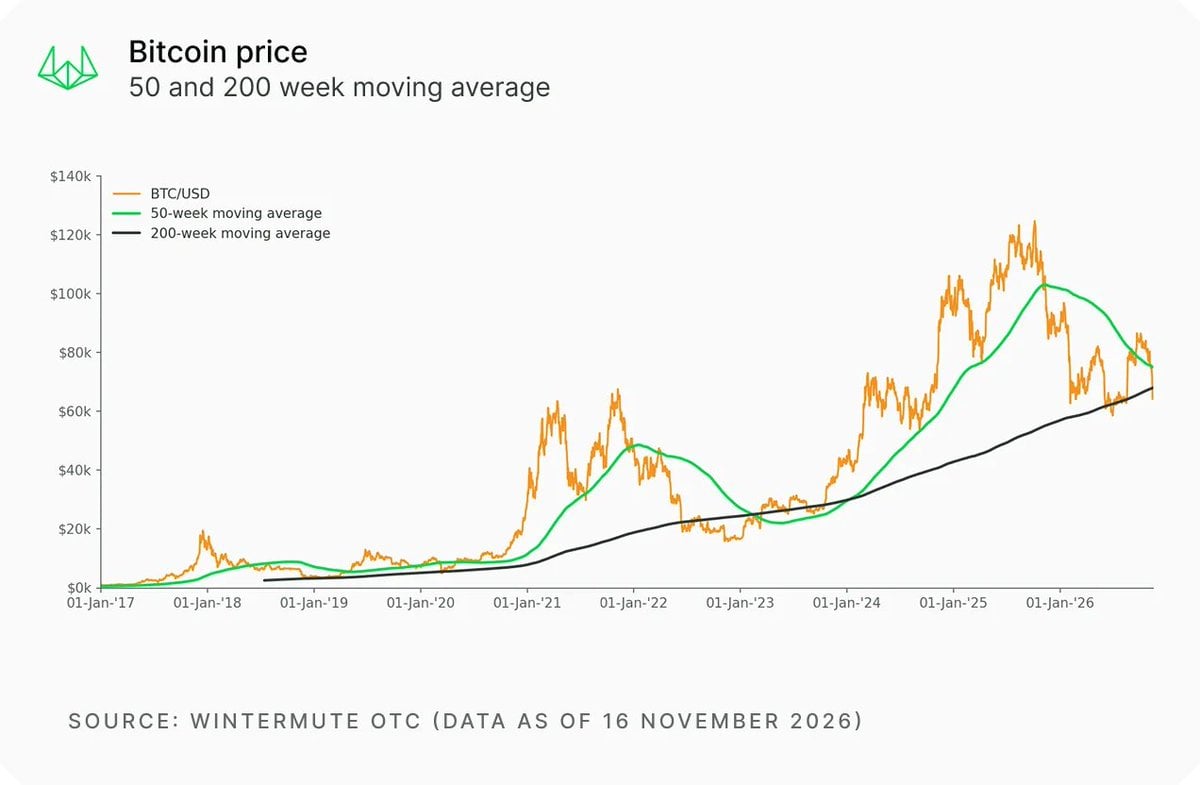
What did Bitcoin’s drop below its 200-week moving average mean? In a market note published on November 17, 2026, Jjay_dm, identified as a Wintermute OTC trader, treated it as a sign of short-term weakness—not proof that Bitcoin had found a bottom.
Bitcoin had fallen 12.7% over the week to $65,400, below the 200-week average near $68,000. The note also reported a Saturday low of $62,000. A moving average describes past prices; crossing it cannot, by itself, establish where the market will go next.
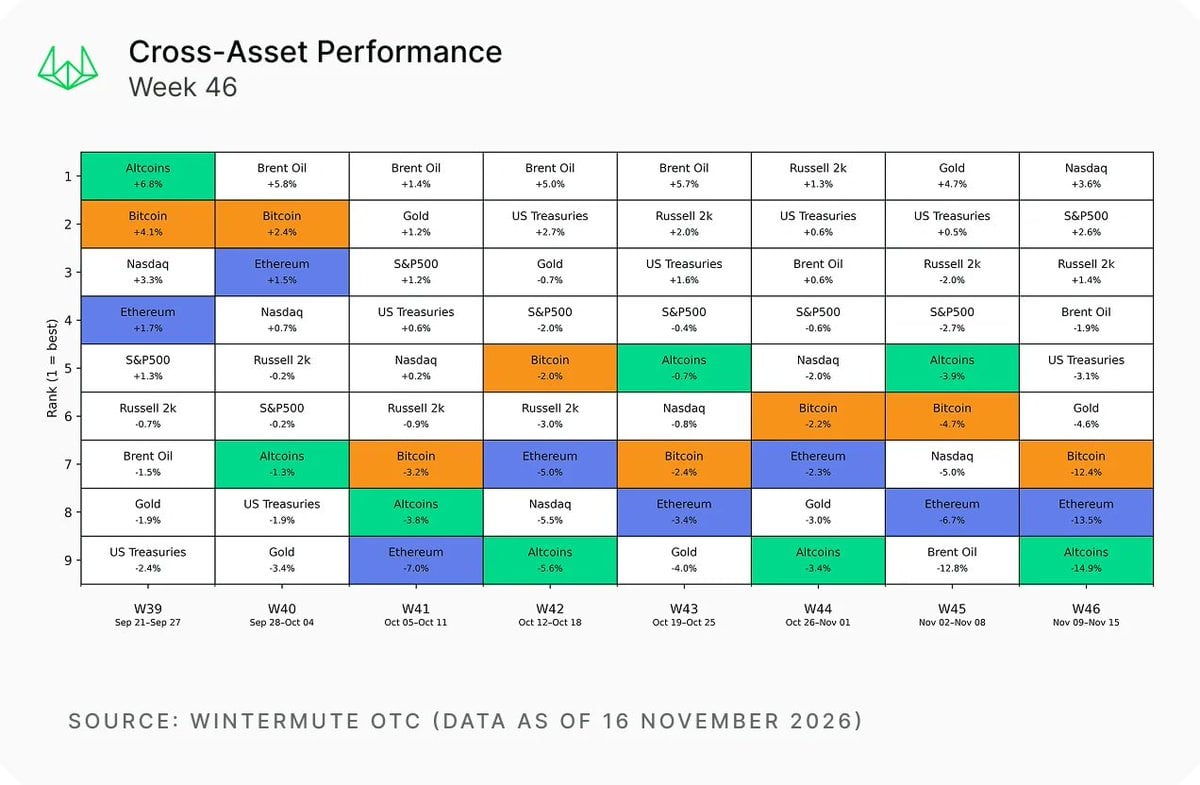
Wintermute linked the sell-off chiefly to a repricing of interest-rate expectations. It reported that the US 10-year Treasury yield had risen about 30 basis points that week to 5.15%, while markets assigned roughly a 92% probability to a December Federal Reserve rate increase. That was market pricing, not an enacted rate decision. Higher bond yields can make an asset that pays no income, such as Bitcoin, less attractive by comparison, but they do not determine its price on their own.
The note pointed to weaker funding channels too. It put US spot Bitcoin ETF net outflows for 2026 to date at about $1.9 billion, against net inflows of $21 billion in 2025 and $35 billion in 2024. It also estimated that stablecoin supply had fallen by $14 billion to $16 billion over the preceding 30 days. Wintermute interpreted these figures as a lack of fresh buying power, rather than evidence that the decline had ended.

Wintermute said it would reconsider its defensive short-term view if Bitcoin closed a day back above the 200-week average with clear spot ETF net inflows, or if forthcoming Fed minutes or October PCE data removed expectations of another January rate increase. Those were conditions for its assessment, not forecasts that either outcome would occur. The limitation is simple: a price level, a flow measure and an interest-rate expectation each capture only part of the market.