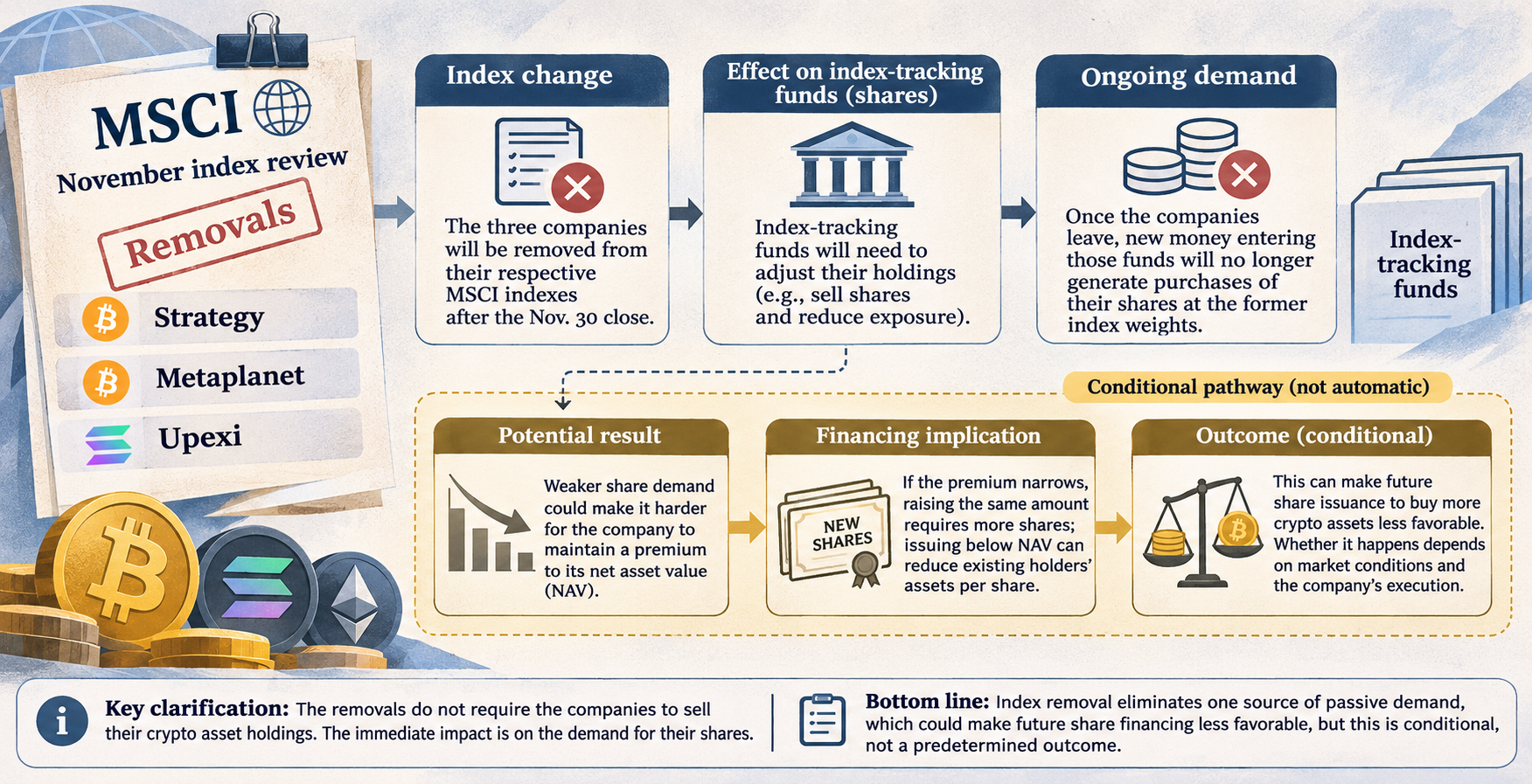
As reported on November 12, 2026, MSCI’s November index review removed three crypto-asset treasury companies: Bitcoin holders Strategy and Metaplanet, and SOL holder Upexi. The changes are scheduled to take effect after the November 30 close. Strategy will leave the MSCI USA Index, Metaplanet the MSCI Japan Small Cap Index, and Upexi the MSCI USA Micro Cap Index.
Does this mean they must sell their holdings? No. The immediate consequence concerns demand for their shares. Funds tracking the affected indexes will need to adjust their positions. Once the companies leave, new money entering those funds will no longer generate purchases at the former index weights.
The removals follow MSCI’s new framework for identifying “non-operating companies,” adopted on October 15, 2026. It examines operating assets alongside measures including operating expenses, cash flow, fair-value changes and reliance on outside financing. That is different from MSCI’s earlier proposal to exclude treasury companies whose digital assets made up at least 50% of total assets; that proposal was not implemented in January 2026. ETH treasury company SharpLink remained on a watch list and was not among the November removals.
For Strategy, the size of any index-related selling remains uncertain. In an earlier consultation response, the company said funds tracking MSCI’s Global Investable Market Indexes held about 13 million MSTR shares, or 3.1% of its basic shares outstanding. At the November 10 close of $121.07, that stake was worth about $1.57 billion. JPMorgan had estimated in 2025 that removal could prompt roughly $2.8 billion in sales, potentially rising to $8.8 billion if other major index providers followed. These are estimates, not confirmed sales. Strategy said the 13 million shares amounted to about 60% of its 30-day average daily trading volume and did not expect a material impact. Trading volume alone cannot establish the effect on price.
The longer-term question is whether reduced share demand makes it harder to finance further purchases. Treasury companies can issue shares to buy more assets most favorably when their stock trades at a premium to net asset value. If that premium narrows, raising the same amount requires more shares; issuing below net asset value can reduce existing holders’ assets per share. Index removal does not determine whether that happens, but it removes one source of passive demand. The test for shareholders remains whether future financing increases the assets attributable to each share.