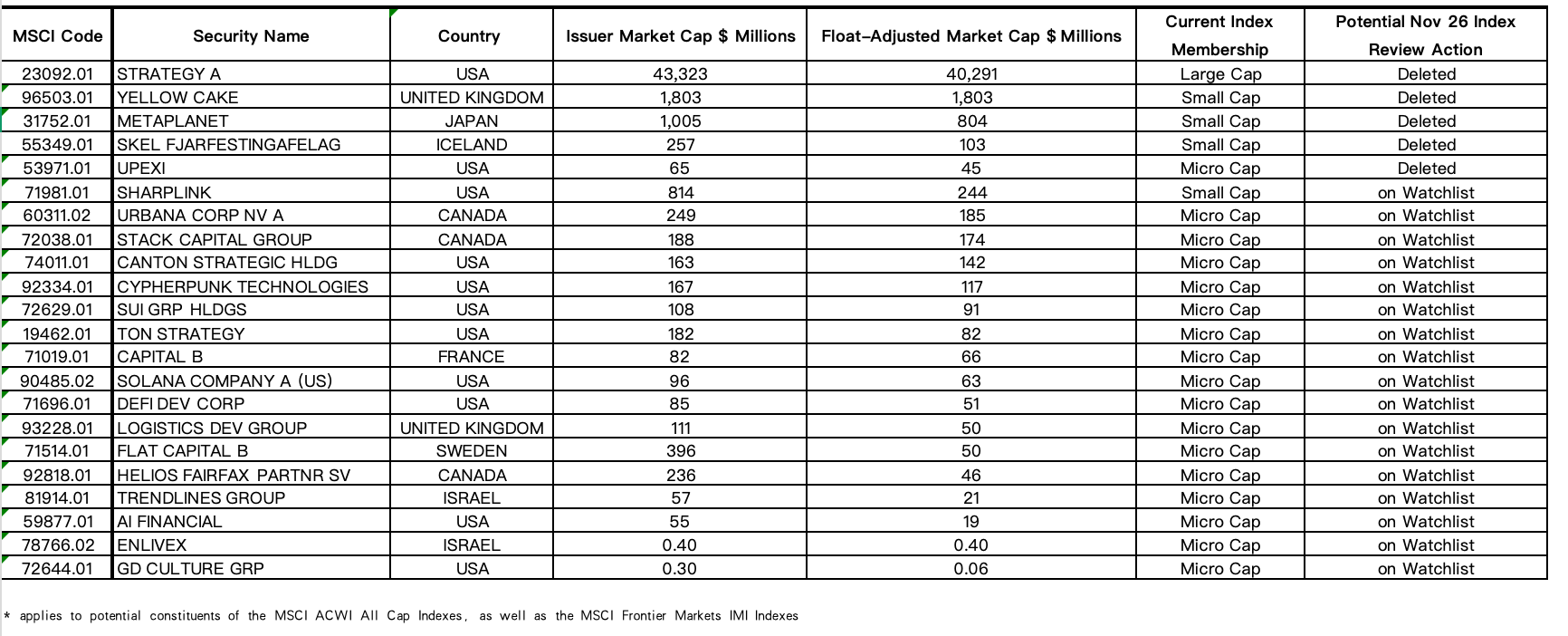
As reported on November 11, 2026, Strategy was on MSCI’s list of companies that could be removed from its global investable market indexes. No final removal had been announced. MSCI’s decision was expected after 6 a.m. Beijing time on November 12.
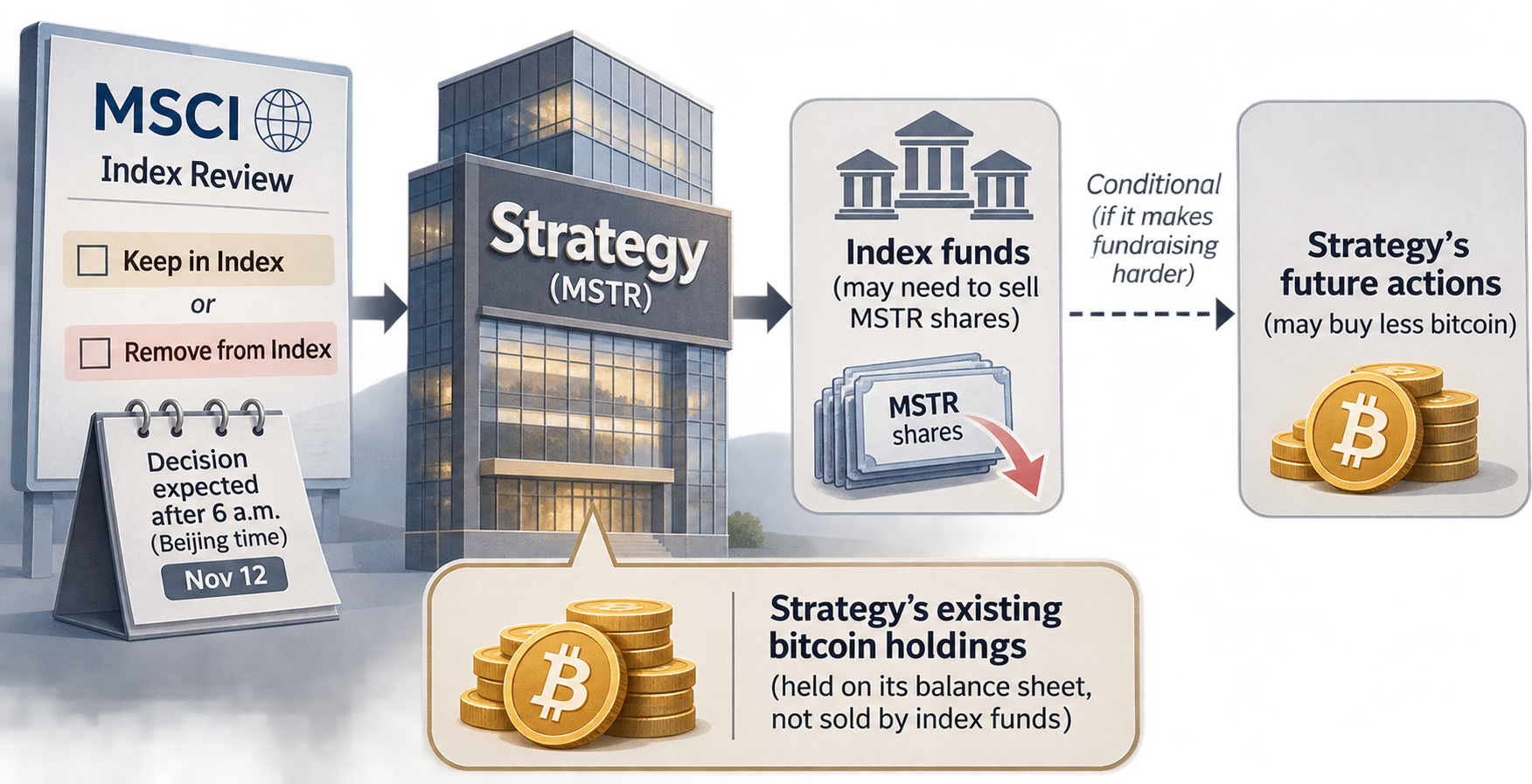
The immediate question is about Strategy’s shares, not the bitcoin it holds. Index-tracking funds may need to sell MSTR if the company is removed. Any effect on Bitcoin would depend on what happens next to Strategy’s ability and willingness to raise money and buy more.
Why is Strategy under review?
MSCI adopted a screening method for companies whose value comes mainly from holding assets rather than operating a business. The method applies from its November index review. MSCI says it is not limited to companies holding crypto assets; its potential-removal list also includes a uranium investment company and an investment holding company.
Strategy disputes the approach. It says it still operates a software business and reports its bitcoin business as an operating segment. MSCI’s list names Strategy as a potential removal, but that designation is not a final index decision.
What would removal mean for MSTR?
Funds that fully replicate an affected index would generally have to sell shares removed from it. Funds using other tracking methods may respond differently, so neither the amount nor the timing of sales is certain.
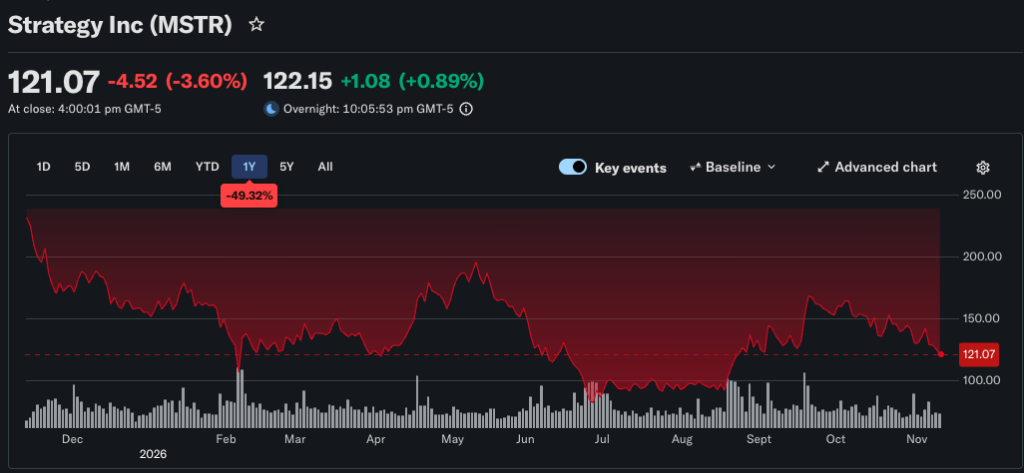
Strategy estimates that passive funds tracking the index hold about 13 million MSTR shares, or 3.1% of its shares. At the November 11 closing price of $121.07, that is worth about $1.57 billion. A separate JPMorgan scenario put potential outflows as high as $2.8 billion if a wider set of benchmark-linked investors exited. These are estimates of possible share sales, not confirmed orders or Bitcoin sales.
Where does Bitcoin enter the picture?
Strategy reported on November 9 that it held 850,364 bitcoin as of November 8, purchased for approximately $64.16 billion in total. Its recent financing illustrates the link: between November 2 and 8, it sold 2.05 million MSTR shares for $283.8 million and bought 1,036 bitcoin for $81.9 million.
If sustained pressure on MSTR reduced what Strategy could raise by issuing shares, future bitcoin purchases could become harder to fund. That is an indirect possibility, not an automatic result of index removal. Selling MSTR held by a fund does not sell bitcoin from Strategy’s balance sheet, and the proposed removal alone does not show that Strategy must sell any bitcoin or establish a measurable effect on Bitcoin’s price.