
The Bank of England drew a distinction in its November 26, 2026 Financial Stability Report: the theft of about $6.4 billion from Binance exposed “weaknesses in firms’ operational controls,” but its effects on the wider financial system were limited. The Bank credited relatively weak links between crypto and mainstream finance. One reason those links were not tested more severely was that Binance committed more than $6.34 billion of its own funds rather than pass the loss to customers.
Who covered the missing assets?
On October 29, attackers drained several Binance hot wallets, the internet-connected wallets the exchange uses to process withdrawals. Binance initially identified a compromised laptop, later reported other breach points and said it had found no evidence that private keys had leaked. The Bank said the attackers appeared to have used social engineering and malware. The theft was more than four times the roughly $1.5 billion stolen from Bybit in February 2025.
Binance said it already held $5 billion in the same tokens that had been stolen, enough to replace about 80% of the loss. It bought the rest on the market and through over-the-counter desks. By November 1, it reported about 95% coverage and had reopened withdrawals for assets including Bitcoin, Ether, USDT and USDC. Deposits had stayed open throughout.
On November 12, Binance said it had replaced all the missing assets. It drew on its corporate treasury, its SAFU emergency fund for users and the portion of its futures insurance fund above its required level. It did not disclose the split. It committed to rebuilding SAFU to about $1 billion.
A proof-of-reserves snapshot at midnight UTC on November 12 covered 198 tokens. It showed that customer balances were backed at that moment, not what Binance owed elsewhere or what it held later. In a court filing, US prosecutors said Binance appeared to have enough assets to cover the loss itself.
The cost to Aave users
The effects within crypto were more visible. According to Aave risk adviser LlamaRisk, a wallet linked to the attacker deposited 60 million USDT on Aave and borrowed 19,762 wrapped Ether, worth about $44.6 million at the time. It was the attacker’s only Aave position, and LlamaRisk reported no bad debt.
To prevent further borrowing against stolen assets, Aave froze 175 reserves on V3 across 16 networks and 117 on V4. Its Horizon market stayed open because it accepted only approved collateral. A freeze was reversible by Aave’s guardian without waiting for a governance vote, but it also prevented ordinary borrowers from adding collateral. They could still repay debt, and liquidations continued.
Withdrawals remained open, though in some pools between 92% and 100% of deposits were lent out. In a fully lent pool, depositors must wait for borrowers to repay. Aave’s risk stewards capped borrowing rates in affected pools at 10% APR and cut roughly $3.7 billion of unused V3 borrowing capacity. The plan to lift restrictions had four phases but no completion dates.
Why USDC matters to the Bank’s assessment
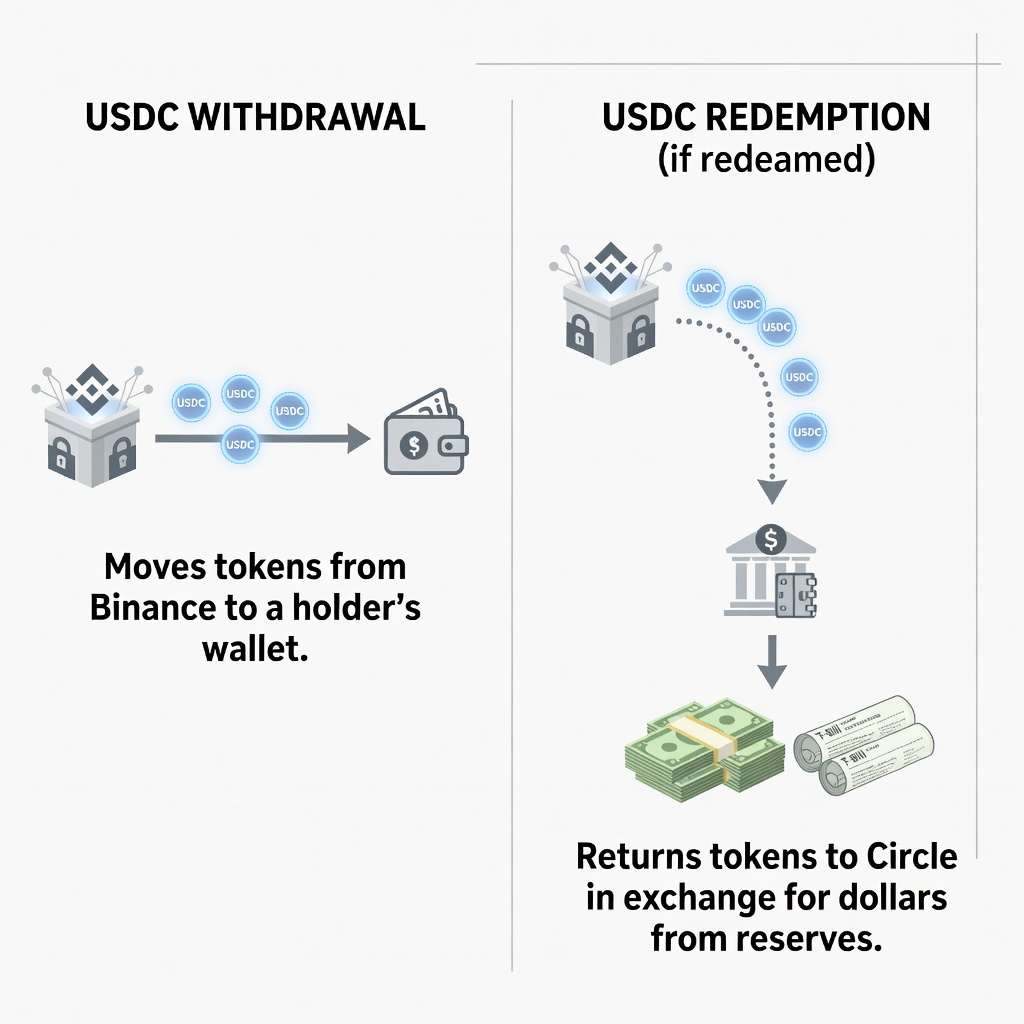
Withdrawing USDC from Binance is not the same as redeeming it for dollars. A withdrawal moves tokens off the exchange. A redemption requires Circle, the issuer, to pay dollars from its reserves. A large wave of redemptions could draw down bank deposits or require sales of short-dated Treasuries. At September 30, Circle reported $73.9 billion of USDC in circulation. The Circle Reserve Fund held $62.5 billion of the reserves; the rest was mostly cash at a handful of large banks.
USDC withdrawals resumed on eight networks in Binance’s first reopening phase. Restoring access and replacing customer assets reduced one reason for customers to seek dollars. But Circle’s public filings did not yet cover the weeks after the theft, so they could not establish whether USDC circulation changed during that period.
Separately, Circle blocked USDC that US prosecutors traced to 36 addresses on 18 blockchains. A court issued a restraining order on November 12. On November 23, the Justice Department sought civil forfeiture of more than $1.1 billion in blocked USDC, attributing the attack to North Korean cyber actors. Prosecutors said US authorities had helped freeze, seize or return more than $2.9 billion in crypto. That combined figure does not say how much Binance recovered; the USDC remained blocked pending the case.
The Bank has judged direct risks from crypto to be limited since at least March 2022, while warning that closer financial ties could change that assessment. The Binance case illustrates a limit to that conclusion: it shows what happened when an exchange could replace stolen customer assets, not how banks or stablecoin reserves would fare if an exchange could not.