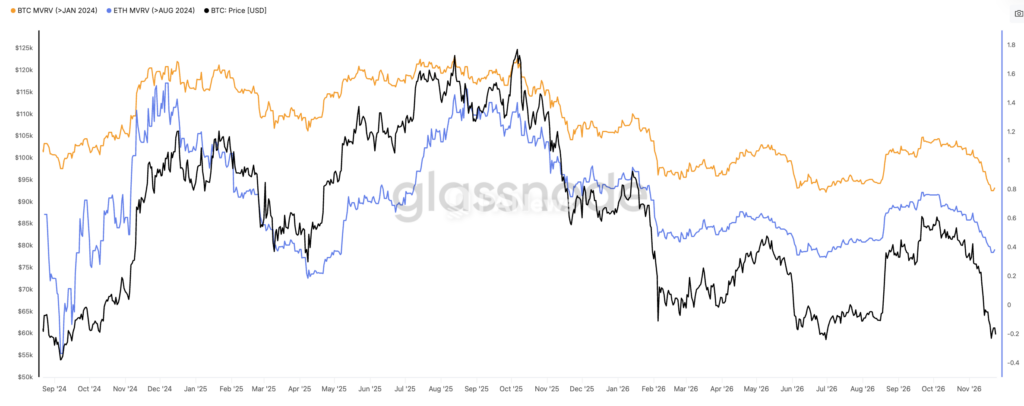
Investors withdrew a net $4.71 billion from U.S. spot Bitcoin ETFs in November 2026 by the time of the November 25 report. According to SoSoValue, that was already the largest monthly net outflow since the funds launched, and about 9.2 times October’s $510 million. BlackRock’s IBIT alone accounted for 88.5% of the November total.
The figures show a reversal in demand for the funds. They do not, however, identify which of the institutions that added Bitcoin ETF shares in the third quarter went on to sell them.
Where the money left
Net outflows from spot Bitcoin ETFs exceeded $5.22 billion in the fourth quarter to date. Nearly $570 million left at the start of the week of November 23, more than a third of the previous week’s net outflow. Bitcoin had fallen below $60,000 without a clear return to net buying through the funds. For IBIT, November’s net outflow of more than $4.17 billion followed several months of net inflows.
Spot Ether ETFs also recorded net outflows after several months of inflows, but their heaviest withdrawals came in October. That month’s $1.61 billion net outflow was a record for the funds, and the week of October 9 saw their second-largest weekly net outflow of 2026. Fourth-quarter net outflows exceeded $2.84 billion by the report date. BlackRock’s ETHA accounted for about $2.44 billion, or 85.9% of the total.
What the institutional filings show
Galaxy Research’s analysis of third-quarter 13F filings found that investment managers had increased their U.S. spot Bitcoin ETF holdings by the equivalent of 49,229 BTC. That more than offset the 47,054 BTC equivalent they had shed over the previous three quarters combined. Reported holdings reached a record 356,491 BTC equivalent, valued at about $29.8 billion. Bitcoin rebounded as high as $87,000 during the quarter.
Alex Thorn, head of research at Galaxy, said dozens of large institutions drove the increase. Investment advisers and wealth management platforms accounted for half the net addition to Bitcoin ETF shares. Bloomberg ETF analyst James Seyffart said more than 2,200 institutions held Bitcoin ETFs as of September 30, with Wells Fargo the largest institutional holder. Advisers were the largest group among those disclosing positions, a mix Seyffart viewed as encouraging because advisers tend to hold investments longer.
The dates matter: the filings describe positions at September 30. They do not show whether those managers kept their shares through November.
Paper losses are not withdrawals
As of November 23, Glassnode put the market-value-to-realized-value ratio, or MVRV, at 0.81 for U.S. spot Bitcoin ETFs and 0.38 for spot Ether ETFs. A ratio of 1 marks aggregate break-even; a reading below 1 means the holdings’ market value is below their estimated cost.
In a separate estimate for the same date, CryptoETF.today put the average Bitcoin ETF cost basis at $80,164 per BTC, about 35.7% above the Bitcoin price at the time. It estimated aggregate unrealized losses at $22.76 billion. For Ether ETFs, it estimated an average cost of $2,974 per ETH against a market price of $1,655, and unrealized losses of about $7.18 billion. Outside the ETF market, Strategy’s Bitcoin holdings and BitMine’s Ether holdings showed paper losses of more than $14.1 billion and $10.3 billion, respectively.
Those estimates measure the decline in value of holdings, not cash taken out of the funds. November’s flow record shows that more money left Bitcoin ETFs than entered them; it does not establish which investors realized losses or what prompted them to sell.