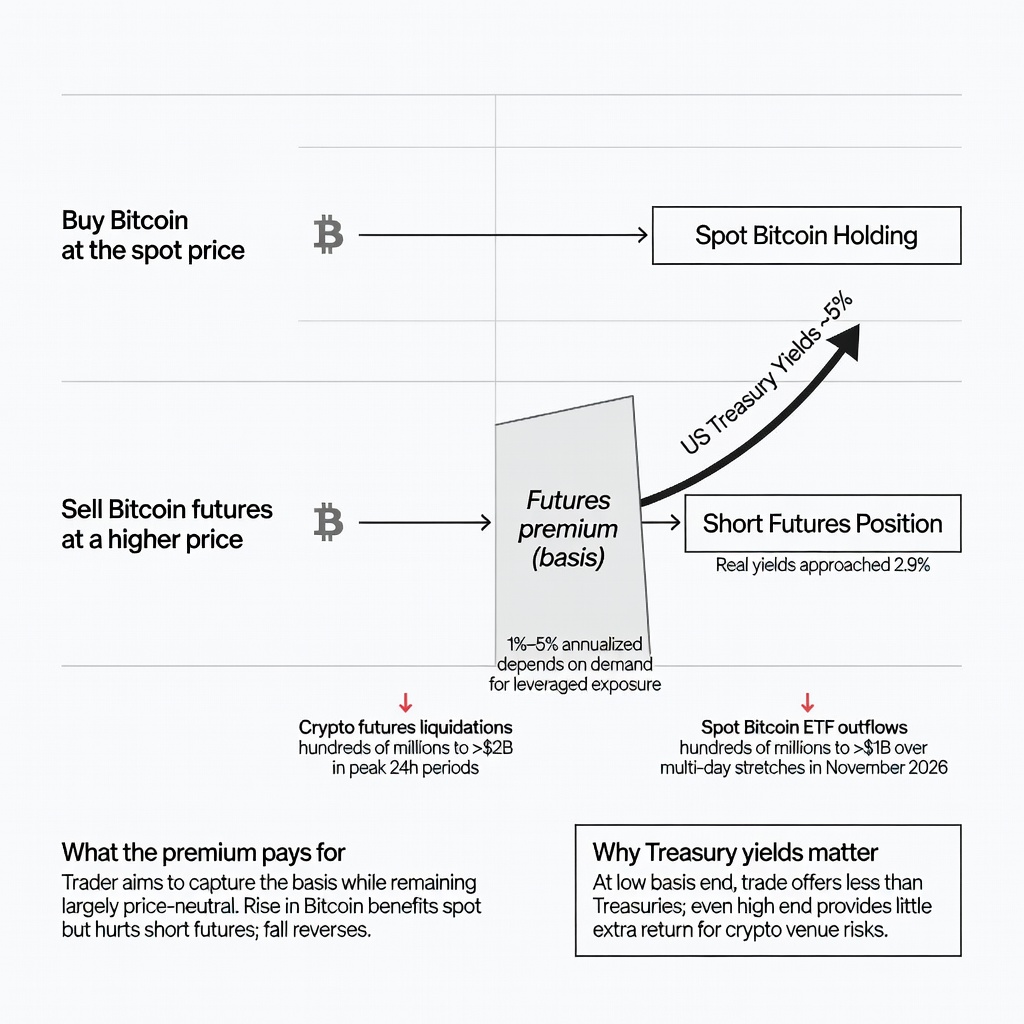
By November 24, 2026, the premium on Bitcoin futures had narrowed to roughly 1%–5% on an annualized basis. With US Treasuries yielding around 5%, a trade that had once offered annualized returns above 20% no longer offered a clear advantage over government debt.
What the futures premium pays for
When a Bitcoin futures contract trades above the price of Bitcoin on the spot market, the difference is called the basis. A trader can buy Bitcoin and sell the higher-priced futures contract. A rise in Bitcoin’s price generally benefits the spot holding but hurts the short futures position; a fall does the reverse. The trade aims to capture the premium rather than profit from a move in Bitcoin’s price.
That premium depends in part on how much buyers are willing to pay for leveraged exposure to Bitcoin. During price declines in November, traders who had borrowed to bet on rising prices were forced to close positions. Crypto futures liquidations ranged from hundreds of millions of dollars to more than $2 billion in peak 24-hour periods. Estimates put the broader reduction in leveraged positions at $3.6 billion to $4 billion. As demand for leveraged positions faded, so did the premium.
Why Treasury yields matter
The 10-year US Treasury yield had reached at least 5.15% several times in 2026. Real yields, which adjust for inflation, had approached 2.9%. At the low end of the reported basis range, the Bitcoin trade offered less than Treasuries; even at the high end, it offered little extra return for the risks of trading on crypto venues.
Some traders hold spot Bitcoin exchange-traded funds (ETFs) and sell futures against those holdings. If the premium stays narrow, some of that ETF demand could unwind. Spot Bitcoin ETFs recorded net outflows ranging from hundreds of millions of dollars to more than $1 billion over several multi-day stretches in November. Those flows do not establish how much, if any, came from traders closing basis positions.