Originally reported November 12, 2026, at 09:18 China Standard Time.
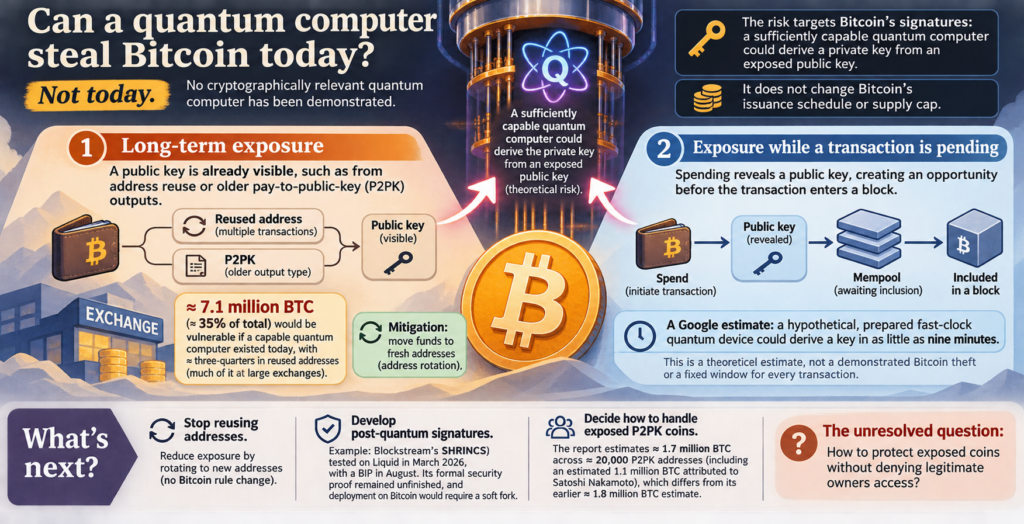
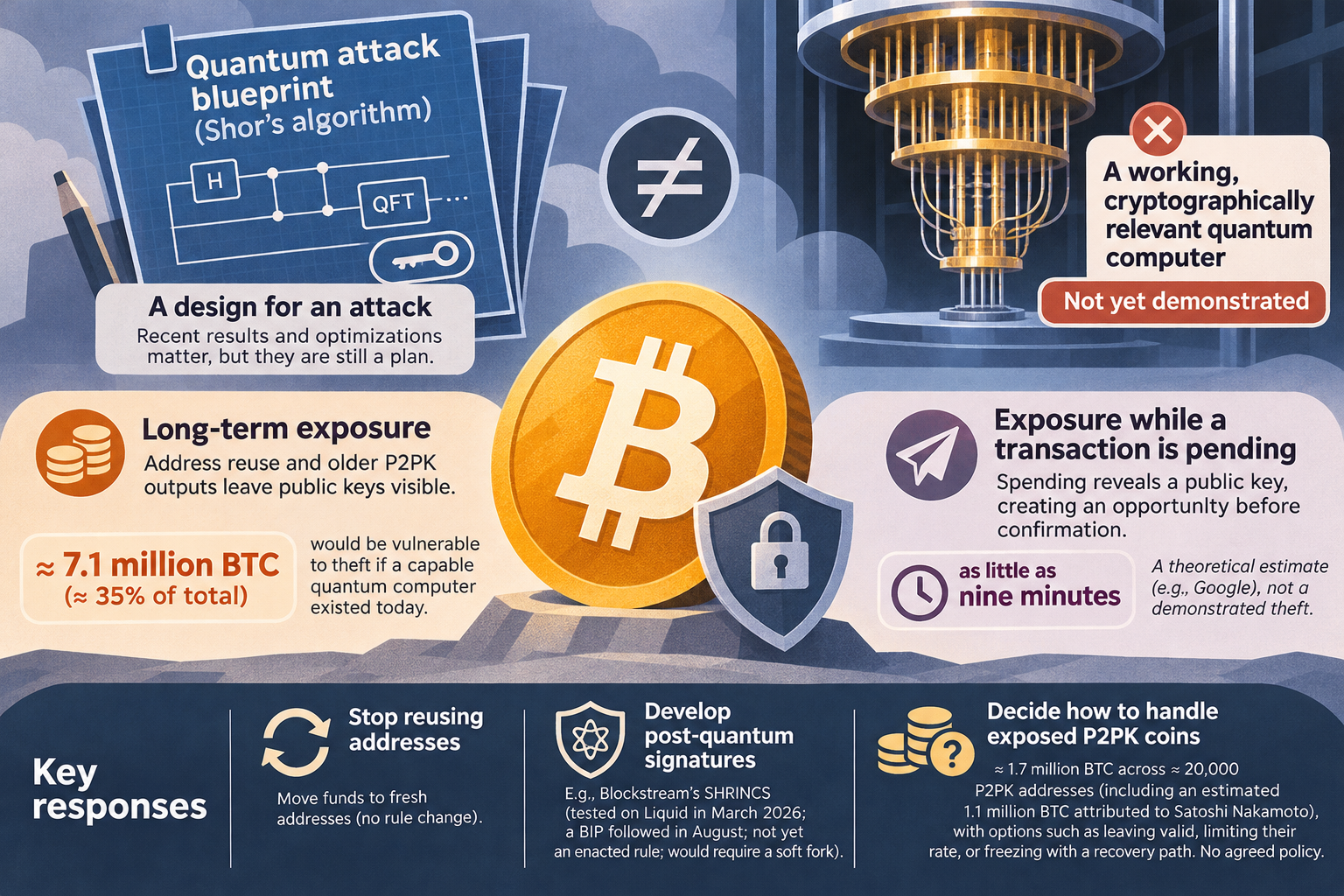
Can a quantum computer steal Bitcoin today? The Bitcoin Security Consortium’s report, prepared with Presidio Bitcoin, says no cryptographically relevant quantum computer has been demonstrated. Recent hardware results and proposed improvements to Shor’s algorithm matter, but a design for an attack is not a machine capable of carrying it out.
The risk concerns Bitcoin’s signatures: a sufficiently capable quantum computer could derive a private key from an exposed public key. It does not, by itself, change Bitcoin’s issuance schedule or supply cap.
Two ways a public key becomes exposed
The first is long-term exposure. Address reuse and older pay-to-public-key (P2PK) outputs leave public keys visible. Citing Project Eleven, the report estimates that roughly 7.1 million BTC, or about 35% of the total, would be vulnerable to theft if a capable quantum computer existed today. It says roughly three-quarters of that amount is in reused addresses, much of it at large exchanges. Moving funds to fresh addresses can reduce that exposure.
The second is exposure while a transaction is pending. Spending reveals a public key, creating an opportunity before the transaction enters a block. The report cites a Google estimate that a hypothetical, prepared fast-clock quantum device could derive a key in as little as nine minutes. That is a theoretical estimate, not a demonstrated Bitcoin theft or a fixed window for every transaction.
What remains unresolved
The report points to three responses: stop reusing addresses, develop post-quantum signatures, and decide how to handle exposed P2PK coins whose owners may no longer have the keys. Address rotation does not require a Bitcoin rule change. A new signature scheme would.
One proposal, Blockstream’s SHRINCS, was tested on Liquid in March 2026; the report says a Bitcoin Improvement Proposal followed in August. Its formal security proof remained unfinished, and deployment across Bitcoin would require a soft fork. It was not an enacted Bitcoin rule at the time of reporting.
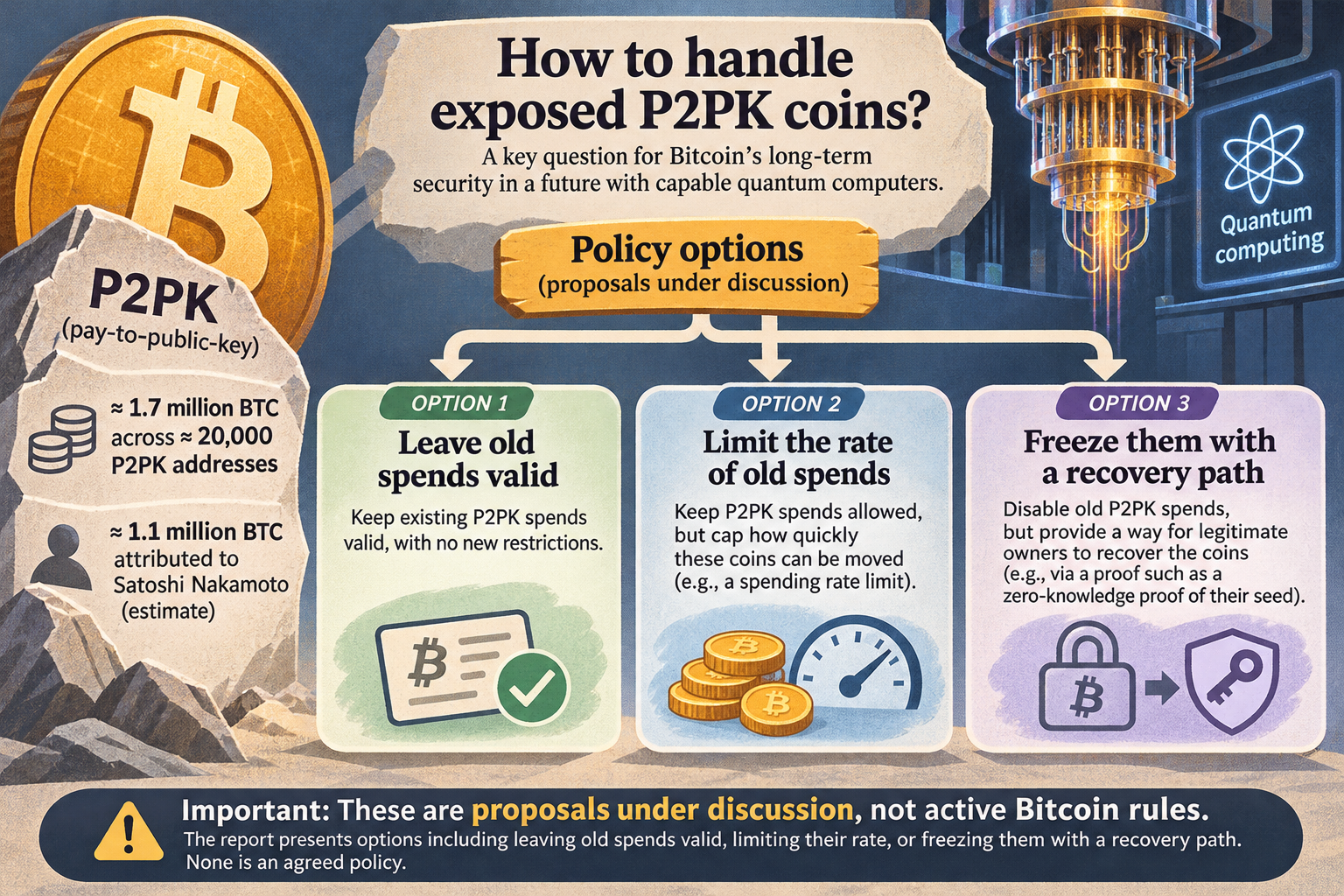
The hardest trade-off concerns coins that cannot be moved by their owners. The report gives an estimate of about 1.7 million BTC across roughly 20,000 P2PK addresses in its discussion of possible rules, including an estimated 1.1 million BTC attributed to Satoshi Nakamoto. That figure differs from its earlier, approximately 1.8 million BTC estimate for P2PK holdings. Presidio Bitcoin describes options including leaving old spends valid, limiting their rate, or freezing them with a recovery path. None is presented as agreed policy. Protecting exposed coins without denying legitimate owners access remains the unresolved question.
Source: chaincatcher.com (originally published 2026-11-12 09:18 UTC+8)