As reported on November 12, 2026, a review of third-quarter results by Blockhead posed a question for listed Bitcoin miners: when does it pay more to lease power capacity to an AI tenant than to keep mining?
The comparison
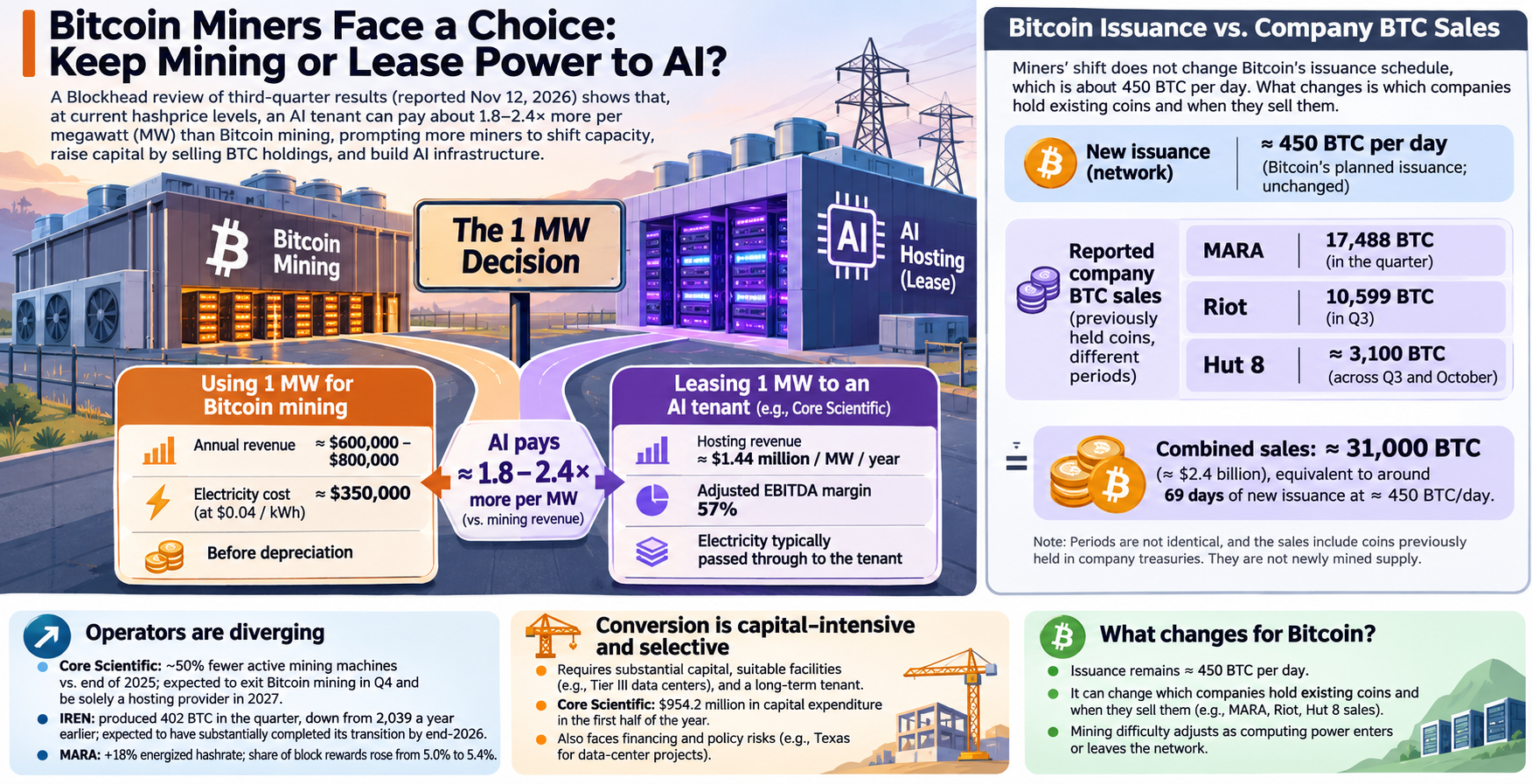
Blockhead estimated that, at the mining revenue levels it examined, an AI tenant could pay 1.8 to 2.4 times as much per megawatt as that megawatt would earn from mining, before mining electricity costs. This is an estimate built from company disclosures and operating assumptions, not a return available to every mine.
According to MillionMiner data cited in the report, hashprice—daily revenue per PH/s of computing power—fell from $40.24 on October 1 to $33.18 at the end of October, a decline of 17.5%. MARA reported a cost of $30.80 per PH/s per day; on that measure, its margin at October’s end was about 7%. At MARA’s owned sites, the report put electricity cost at $39,674 per BTC using a power price of $0.04 per kWh, roughly 55% of its stated average sale price of $71,688.
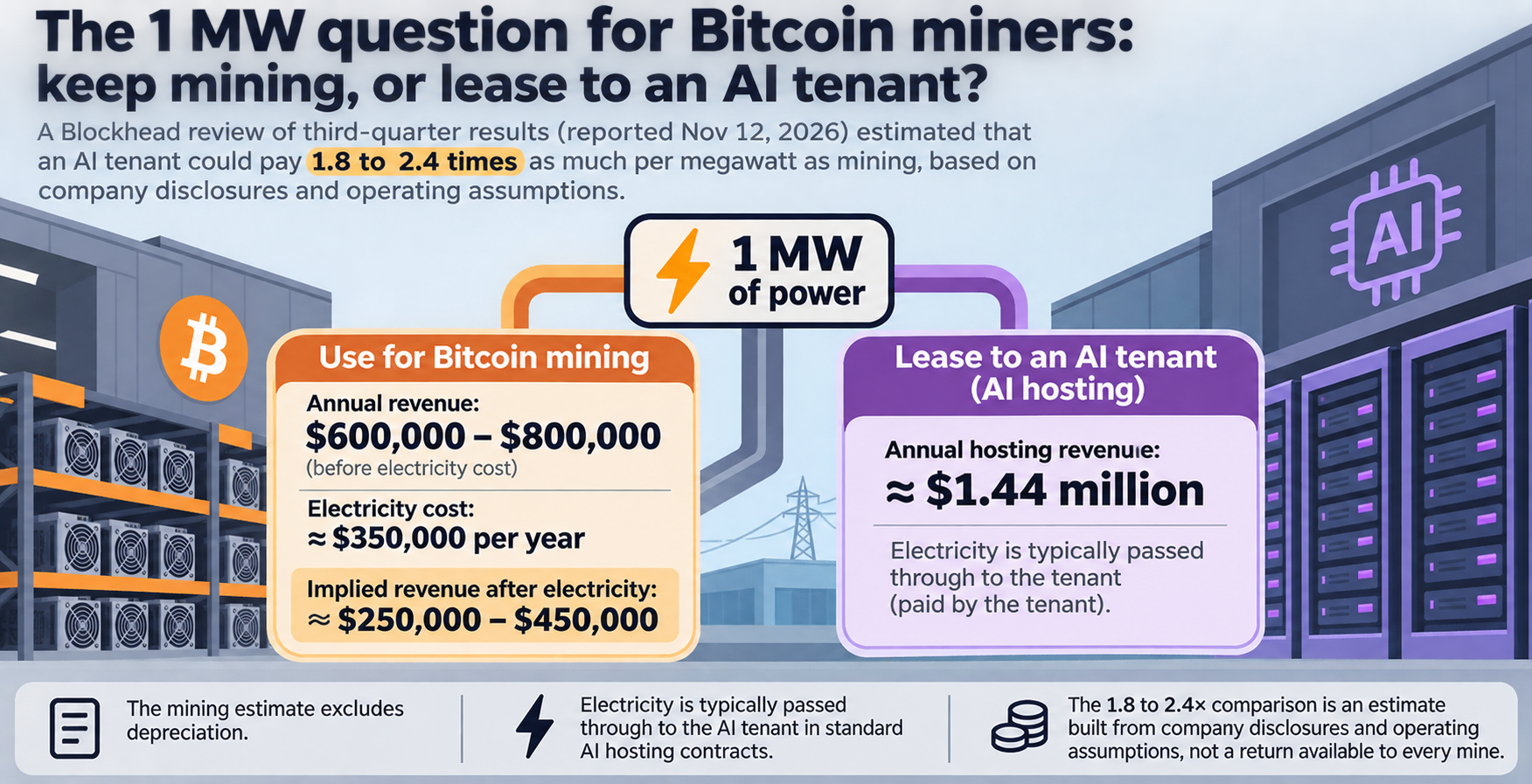
Core Scientific, by contrast, disclosed 485 MW of billable power capacity associated with more than $700 million in annualized hosting revenue—about $1.44 million per MW per year—and a 57% adjusted EBITDA margin. Blockhead estimated that one megawatt used for mining, with machines operating at 15–20 joules per TH and hashprice near $33, would produce $600,000–$800,000 in annual revenue, before roughly $350,000 in electricity costs at $0.04 per kWh. Those assumptions exclude depreciation. Blockhead noted that standard AI hosting contracts typically pass electricity costs through to tenants, making the two businesses’ revenue and cost structures different.
HIVE’s reported margins show a similar contrast within one company: 34% gross margin for Bitcoin mining versus 51% for high-performance computing and AI services. Its stated 80% adjusted EBITDA margin for new GPU clusters was a target, not a reported result. HIVE also reported a $78.7 million GAAP loss that included a non-cash impairment tied to falling mining-machine values.
What changes for Bitcoin?
The miners’ shift does not change Bitcoin’s issuance schedule. The report put new issuance at approximately 450 BTC per day. It can change, however, which companies hold existing coins and when they sell them.
According to a shareholder letter cited by Blockhead, MARA sold 17,488 BTC during the quarter, versus 2,247 BTC mined, and planned further sales to fund AI infrastructure and meet note obligations. Riot sold 10,599 BTC in the third quarter; Hut 8 sold about 3,100 BTC across the third quarter and October. Blockhead put the combined sales at roughly 31,000 BTC, or about $2.4 billion—equivalent to around 69 days of new issuance at the cited rate. The periods are not identical, and the sales include coins previously held in company treasuries. They should not be read as newly mined supply.

Mining capacity can also move between operators. Blockhead reported that Core Scientific had nearly 50% fewer active mining machines than at the end of 2025, while IREN produced 402 BTC in the quarter, down from 2,039 BTC a year earlier. Core expected to finish exiting Bitcoin mining in the fourth quarter and become solely a hosting provider in 2027; IREN expected to have substantially completed its transition by the end of 2026. These were company expectations at the time of reporting. MARA, meanwhile, reported an 18% increase in energized hashrate and a rise in its share of block rewards from 5.0% to 5.4%.
The limiting point is that an AI lease is not simply a higher mining reward. Converting a site requires substantial capital, suitable facilities and a tenant able to honor a long contract. Blockhead reported $954.2 million in Core Scientific capital expenditure in the first half of the year; its account also described financing and Texas policy risks for data-center projects. And the megawatt comparison applies to sites that can make the conversion. For those sites, AI demand may raise the price of staying in mining; for Bitcoin, mining difficulty adjusts as computing power enters or leaves the network.
Source: techflowpost.com (originally published 2026-11-12 17:31 UTC+8)