
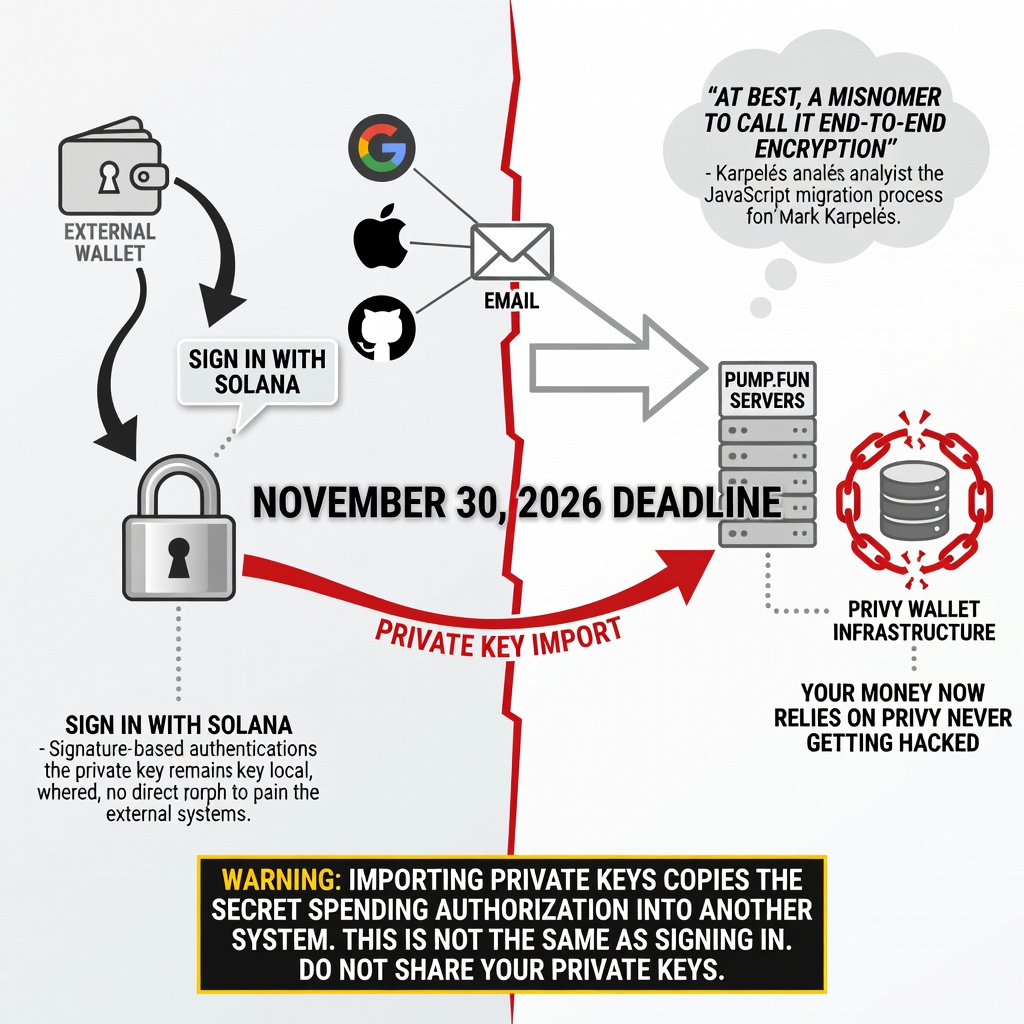
The question is simple: if Pump.fun asks you to import a private key so you can keep using the same account, who can spend the coins? Importing the key is not the same as signing in. It copies the secret that authorizes spending into someone else’s system.
On November 23, 2026, former Mt. Gox chief executive Mark Karpelès warned users of Pump.fun, a Solana memecoin launchpad, about that migration. He described potential risk from how the new login is built. The report does not say that keys were stolen, or that Privy or Pump.fun had been breached.
Pump.fun set a November 30, 2026, deadline to stop external-wallet logins on its website. After that, access would be through email and social logins, including Google, Apple, and GitHub. To keep a current account, the platform is asking users to import their private keys. Karpelès argues that this import is what can put the assets at risk.
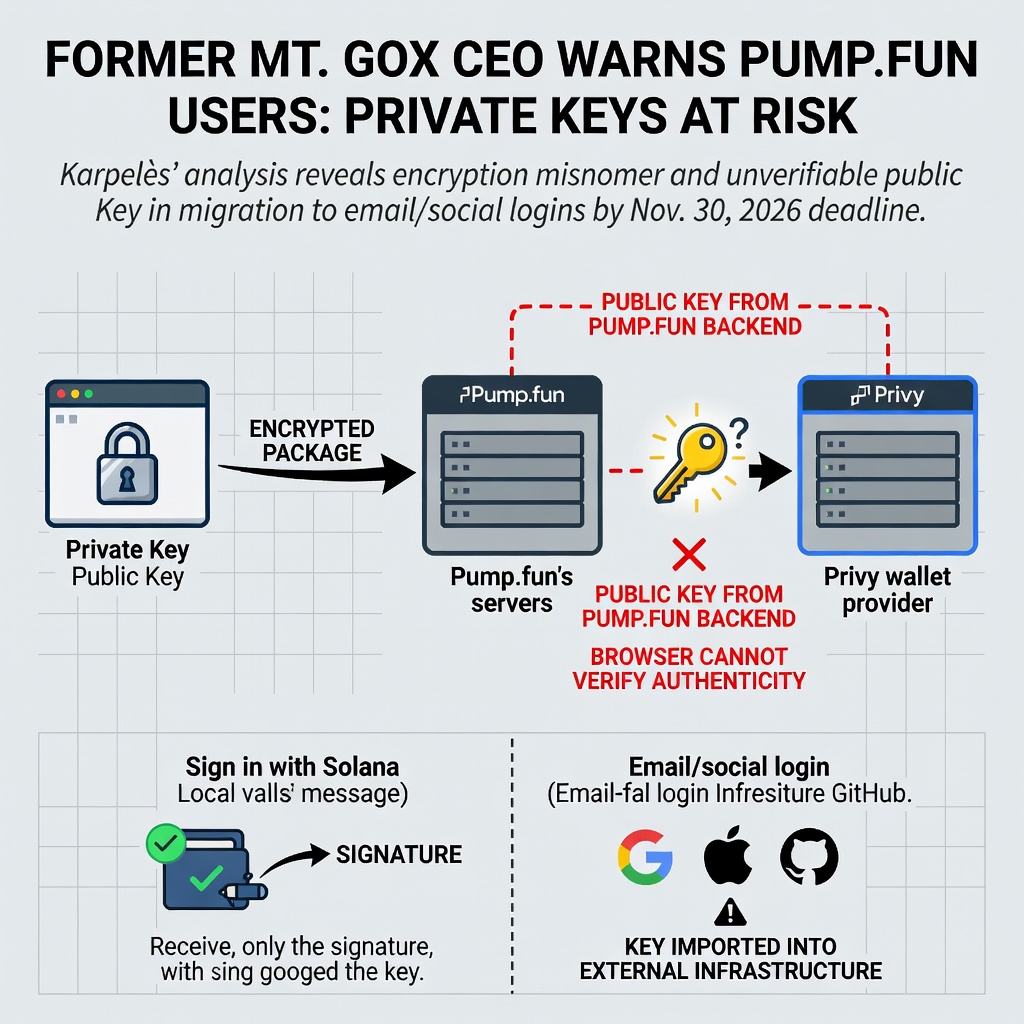
A private key is the secret that approves a spend. A signature made with that key can prove you hold it. Giving up the key itself gives up the ability to move the coins.
In a post on X, Karpelès said he read Pump.fun’s JavaScript to see how the migration works. On his account, the key is first encrypted in the user’s browser, then sent through Pump.fun’s servers to Privy, the wallet infrastructure provider. He said that calling this end-to-end encryption is, at best, a misnomer.
He also said the public key used for that encryption comes from Pump.fun’s backend, and that the browser has no way to check whether the key is authentic. If the supplied key is not the one the user thinks it is, encryption does not keep the secret from the party that provided it.
His other concern is where the trust then sits. “Your money also now relies on Privy never getting hacked,” he wrote. That is a warning about dependence, not a claim that such a hack has happened.
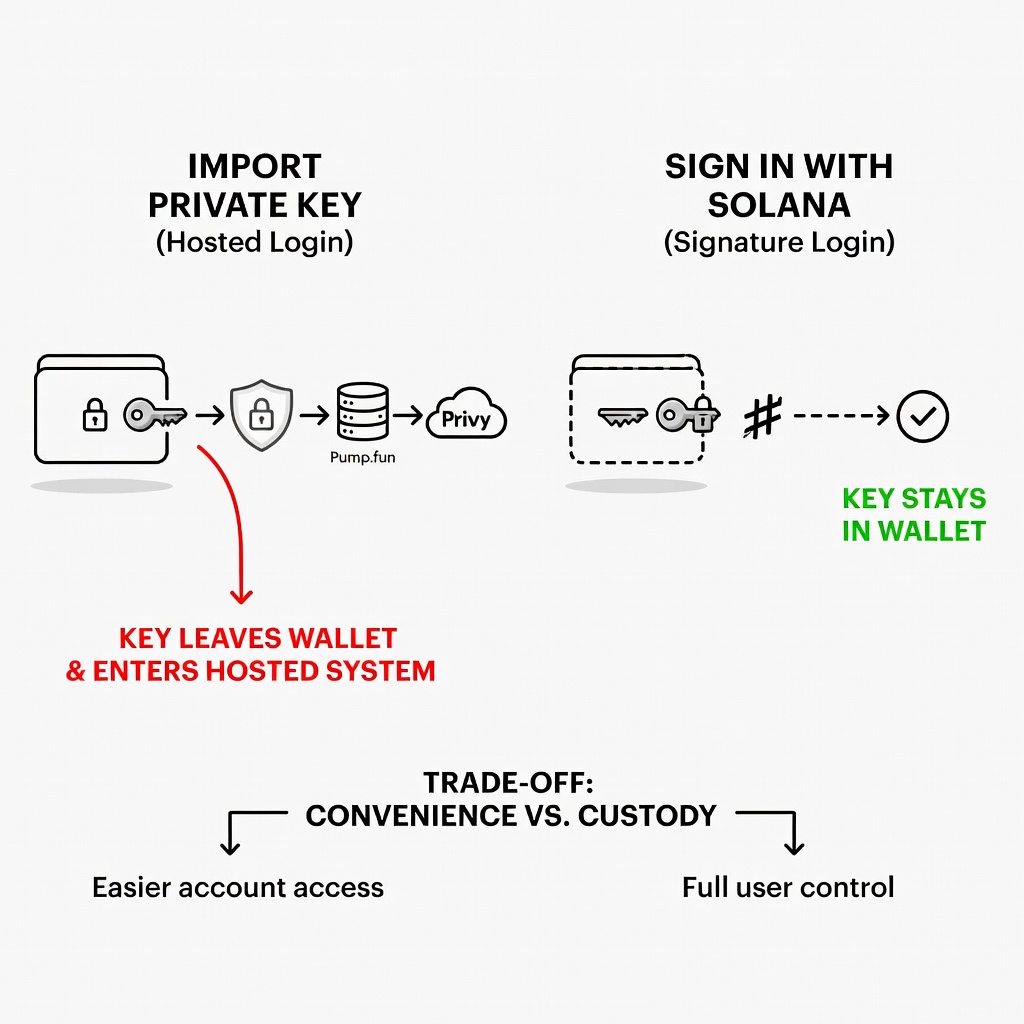
Karpelès argues the import is unnecessary. He said Pump.fun already uses a “Sign in with Solana” message to prove that a wallet is owned. In that pattern, the wallet signs locally. The site receives the signature, not the key. Ownership can be shown, and transactions can be approved, without placing the private key in a new system. He presented that as something the platform could do, not as a change it had already made.
The trade-off is convenience against custody. Email and social login can make an account easier to reopen, but only after the key has been imported into infrastructure the user does not hold. A signature login, as Karpelès describes it, leaves the key where it was. His warning is an analysis of client code and of what the migration asks people to do. It is not confirmation of a loss, and it does not establish what either company would do with a key after it arrives.